Nest box entrance hole sizes, smallest to largest
Sorted by entrance diameter. The hole size is a filter: anything larger than the bird can squeeze through is shut out. Figures from the NestWatch and U.S. Fish and Wildlife Service tables.

| Hole | Species | Keeps out |
|---|---|---|
| 1 to 1 1/4 in | House Wren | House sparrows, starlings |
| 1 1/8 in | Black-capped Chickadee | House sparrows, starlings |
| 1 1/8 in | Carolina Chickadee | House sparrows, starlings |
| 1 1/4 in | Bewick's Wren | European starlings |
| 1 1/4 in | Tufted Titmouse | European starlings |
| 1 1/4 in | Red-breasted Nuthatch | European starlings |
| 1 1/4 in | Downy Woodpecker | European starlings |
| 1 1/4 in | Prothonotary Warbler | European starlings |
| 1 3/8 in | White-breasted Nuthatch | European starlings |
| 1 1/2 in | Eastern Bluebird | European starlings |
| 1 1/2 in | Tree Swallow | European starlings |
| 1 1/2 in | Violet-green Swallow | European starlings |
| 1 1/2 in | Carolina Wren | European starlings |
| 1 1/2 in | Hairy Woodpecker | European starlings |
| 1 1/2 in | Ash-throated Flycatcher | European starlings |
| 1 9/16 in | Western Bluebird | European starlings |
| 1 9/16 in | Mountain Bluebird | European starlings |
| 1 3/4 in | Great Crested Flycatcher | Nothing large; monitor for starlings |
| 2 in | Red-headed Woodpecker | Nothing large; monitor for starlings |
| 2 1/8 in (or a starling-resistant crescent) | Purple Martin | Nothing large; monitor for starlings |
| 2 1/2 in | Red-bellied Woodpecker | Nothing large; monitor for starlings |
| 2 1/2 in | Northern Flicker | Nothing large; monitor for starlings |
| 3 in | Eastern Screech-Owl | Nothing large; monitor for starlings |
| 3 in | American Kestrel | Nothing large; monitor for starlings |
| 3 x 4 in oval | Wood Duck | Nothing large; monitor for starlings |
| 6 in | Barn Owl | Nothing large; monitor for starlings |
Boxes with the right hole, ready to mount
Prices move constantly; the button shows the current figure.

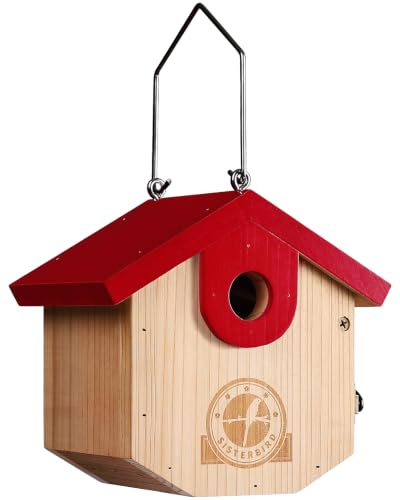


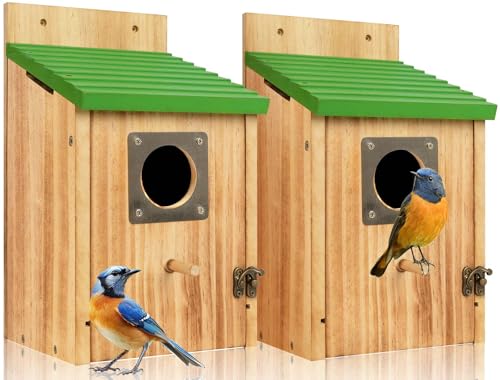

A metal hole guard or a portal around the entrance stops squirrels and woodpeckers from enlarging a hole. For every other dimension see the full birdhouse dimensions chart.
Get the printable checklist
One page with every item, the placement distances and the cleaning schedule. We send it once. No sales sequence.
Used only to send the checklist.Frequently asked questions
What size hole is best for a birdhouse?
There is no single best size; choose by species. 1 1/8 inches suits chickadees and keeps out house sparrows. 1 1/4 inches suits titmice, nuthatches and downy woodpeckers. 1 1/2 inches is the eastern bluebird and tree swallow standard and excludes starlings. Larger holes suit flycatchers, woodpeckers, martins, kestrels and owls, and need more monitoring.
Can a bluebird fit through a 1 1/4 inch hole?
No. Eastern bluebirds need a 1 1/2 inch round hole, and western and mountain bluebirds are often given 1 9/16 inches. A 1 1/4 inch hole is too small and will be used by chickadees, titmice, nuthatches or wrens instead. An oval entrance about 1 3/8 by 2 1/4 inches is an accepted alternative on some bluebird box designs.
How do I keep starlings out of a birdhouse?
Keep the entrance at 1 1/2 inches or smaller: starlings need a larger hole. For purple martins, whose 2 1/8 inch hole starlings can use, starling-resistant crescent entrances are widely used. Remove starling nests promptly, since they are an invasive species not protected under U.S. law, unlike native cavity nesters whose nests must be left alone.
Should the hole be round?
Round is standard and works for nearly every species. Slotted or oval entrances are used on some bluebird designs, and crescent-shaped entrances are used on purple martin housing to exclude starlings. Whatever the shape, keep edges smooth and the hole at the published height above the floor so nestlings stay out of reach.
Why is a squirrel chewing my birdhouse hole?
Squirrels and woodpeckers enlarge entrances to get at nests or to use the box themselves. A metal or slate hole guard fixed around the entrance stops the chewing and keeps the hole at its original size. Mounting the box on a smooth metal pole with a baffle, away from trees, keeps squirrels from reaching it at all.