Purple Martin house: dimensions and placement
Colonial nester. Use a telescoping or winch pole so compartments can be lowered for checks. Larger 7 x 12 inch compartments are now preferred by many landlords.

What are the purple martin house dimensions?
| Inside floor | 6 x 6 in |
|---|---|
| Floor to roof | 6 in |
| Entrance | 2 1/8 in (or a starling-resistant crescent) |
| Hole above floor | 1 to 2 in |
| Mounting height | 10 to 20 ft |
| Habitat | Wide open space, at least 40 to 60 feet from trees and 30 to 100 feet from a house. |
| Range | Eastern and central US; local in the West |
Source: Cornell Lab NestWatch nest box table and U.S. Fish and Wildlife Service "Homes for Birds". Build one from these numbers with the birdhouse calculator, which adds a board cut list.
More boxes that fit
Prices move constantly; the button shows the current figure.


Where should a purple martin house go?
Wide open space, at least 40 to 60 feet from trees and 30 to 100 feet from a house. Mount on a smooth metal pole where possible, fit a predator guard, and face the entrance away from prevailing wind. Leave the box up through winter as a roost, and clean it out after each brood.
Watch the nest without disturbing it
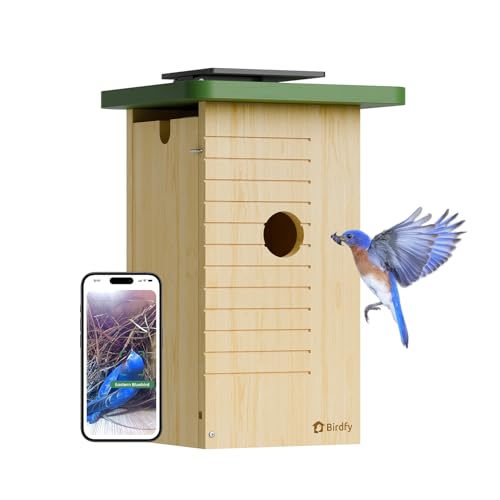
Nest box cameras let you follow eggs and chicks without opening the box.

Nest box dimensions for other species
Eastern Bluebird · Western Bluebird · Mountain Bluebird · Tree Swallow · Violet-green Swallow · House Wren · Carolina Wren · Bewick's Wren · Black-capped Chickadee · Carolina Chickadee · Tufted Titmouse · White-breasted Nuthatch · Red-breasted Nuthatch · Downy Woodpecker · Hairy Woodpecker · Red-bellied Woodpecker · Red-headed Woodpecker · Northern Flicker · Prothonotary Warbler · Great Crested Flycatcher · Ash-throated Flycatcher · Eastern Screech-Owl · American Kestrel · Barn Owl · Wood Duck · American Robin · Barn Swallow · Eastern Phoebe
Birds that do not use boxes: Cardinals · Blue Jays · Mourning Doves · Goldfinches · Hummingbirds · Orioles · House Finches
Get the nest box season checklist
When to put boxes up, when to clean them out, and the hole sizes for every common species, on one page.
Used only to send the checklist.Frequently asked questions
What size hole does a purple martin need?
The published figure is 2 1/8 in (or a starling-resistant crescent), drilled 1 to 2 inches above the floor. Holes this large admit starlings, so monitor the box and remove starling nests, which are not protected. Keep the edge smooth and never add a perch.
How high should a purple martin house be mounted?
Mount it 10 to 20 feet above the ground. Wide open space, at least 40 to 60 feet from trees and 30 to 100 feet from a house. A smooth metal pole with a predator guard or baffle is safer than a tree trunk or wooden fence post, which cats, raccoons and snakes can climb. Face the entrance away from prevailing wind and afternoon sun where you can.
Where do purple martins live?
Eastern and central US; local in the West. Wide open space, at least 40 to 60 feet from trees and 30 to 100 feet from a house. A box put up outside the species' range or in the wrong habitat will simply be taken by whatever local cavity nester does fit, which is often a wren, chickadee or house sparrow.
When should I put up a purple martin house?
Late winter, before birds start choosing sites in early spring, is ideal. Boxes put up later still attract second nesting attempts and late arrivals. Clean old nesting material out after each brood fledges and again before the next season; many small birds also use empty boxes as winter night roosts.
What should go inside a purple martin box?
Nothing. Purple Martins build their own nest. Colonial nester. Use a telescoping or winch pole so compartments can be lowered for checks. Larger 7 x 12 inch compartments are now preferred by many landlords. Use untreated wood, drill 1/4 inch drainage holes in the floor and leave ventilation gaps under the roof.