Where to Mount a Birdhouse: Height, Direction and Spacing
Most nesting failures trace back to placement, not the box itself: too low and easy for a cat to reach, facing straight into afternoon sun and prevailing storms, or mounted on a tree trunk that gives squirrels and snakes a ladder straight to the eggs. A smooth pole like the Bird House Pole, 60 Inch Heavy Duty Mount Kit solves the mounting problem before you even pick a box, since height, angle and guard placement matter more than box style for whether a pair actually moves in.

How high should a birdhouse be mounted?
Height depends on the species a box is built for. Most backyard nest boxes go up between eye level and about ten feet, low enough to check and clean without a ladder, high enough to feel out of casual reach.
| Species | Mounting height | Entrance hole |
|---|---|---|
| Eastern bluebird | 4 to 6 feet | 1 1/2 in |
| House wren | 4 to 10 feet | 1 to 1 1/4 in |
| Black-capped chickadee | 4 to 8 feet | 1 1/8 in |
| Downy woodpecker | 6 to 20 feet | 1 1/4 in |
| Eastern screech owl | 10 to 20 feet | 3 in |
| Purple martin | 10 to 20 feet, on a pole | 2 1/8 in per compartment |
Purple martin housing and screech owl boxes are the outliers: martins want height and wide open sky around the pole, and owl boxes are often set on a tree trunk well above head height rather than at the eye-level range most songbird boxes use. See the nest box hole size chart for the full list by species.
Which direction should the entrance face?
Across most of North America, an entrance facing east or northeast works best. That catches gentle morning sun to warm the box after a cool night, while avoiding the harsh late-day heat that a west-facing hole would trap inside a small cavity during summer. It also tends to turn the opening away from the driving rain and wind that arrive from the west and southwest during most storm systems.
A slight forward tilt, with the roof a little lower than the floor at the front, helps rain run off the roof edge instead of dripping straight down into the entrance hole. If the only available mounting spot faces a less ideal direction, a deeper overhang on the roof line matters more than the compass heading itself.
How far apart should birdhouses be spaced?
Same-species pairs are territorial, and spacing that ignores this is one of the most common reasons a second box on the same property sits empty all season.
- Bluebird boxes: at least 100 feet apart, closer to 300 feet in prime open habitat.
- Paired bluebird and tree swallow boxes: 15 to 20 feet apart is close enough for a tree swallow to use the second box without the two species fighting over one hole.
- Wren boxes: less territorial about distance, but a clear sightline or roughly 10 feet between boxes avoids constant squabbling.
- Purple martin housing: 40 feet or more from the nearest tree line, set over open lawn rather than near a garden edge.
Boxes for different species, like a Nature's Way Cedar Bluebird House with Predator Guard and a wren box on the same property, do not need the same spacing rules against each other since the two are not competing for the same cavity.
How do you keep predators out of a birdhouse?
A predator guard, usually a stovepipe or cone-shaped baffle, mounts on the pole below the box rather than on the box itself. The bottom edge of the guard should sit 4 to 5 feet off the ground, since that is roughly the reach of a jumping or climbing predator: squirrels can jump about 8 to 10 feet horizontally and 4 to 5 feet straight up, and raccoons and snakes rely on the same climbing routes a guard is meant to block.
Boxes that ship with a built-in guard, like the Kingsyard Wren House with Predator Guard, start ahead, but any box benefits from an added pole baffle, since the box guard alone does not stop a predator from reaching the pole itself. Keep the pole away from any fence, roofline or branch a predator could jump across from, since a guard only works if the pole is the sole route up.
Gear for this job
Prices move constantly; the button shows the current figure.


Pole or tree: where should a birdhouse actually mount?
A smooth metal pole fitted with a baffle is the safer choice in nearly every case. A tree trunk gives climbing predators an easy route no matter where a guard sits on the box itself, since bark provides grip a smooth pole does not.
Tree mounting only makes sense for species that naturally expect it, like the eastern screech owl or downy woodpecker, both of which nest in tree cavities in the wild. Even then, a metal guard plate around the entrance hole helps stop predators or squirrels from chewing the opening larger.
When should a birdhouse go up?
Put boxes up before nesting season begins, so resident and migrating pairs can find and inspect them while they are still scouting territory in early spring. Many boxes can stay up through the colder months too, since chickadees and wrens will use an empty box as winter roosting shelter on hard nights.
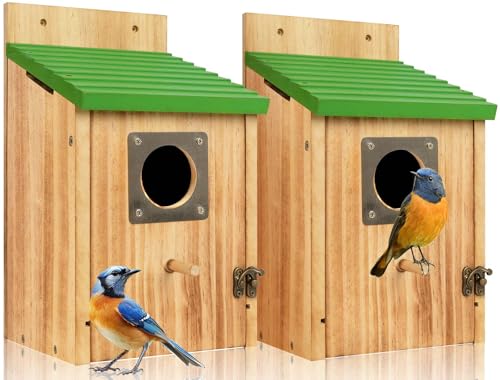
A general-purpose box like the 2 Pack Cedar Bird House with Metal Predator Guard works well for testing a new spot for a season before committing to a full nest box trail with species-specific boxes and spacing.
How and when should a birdhouse be cleaned out?
Open the clean-out door as soon as a brood fledges and remove the old nesting material. Several species, including bluebirds and wrens, will attempt a second brood in the same box within one season, and they settle in and start a fresh nest faster in a cleared cavity than one still packed with old grass.
Do a full clean at the end of the season: scrape out all debris, and if there is any sign of parasites, mites or disease, wipe the interior with a diluted solution of 1 part bleach to 9 parts water, then rinse and dry it completely before the box goes back up for winter or the next season.
What you need
Prices move constantly; the button shows the current figure.

Get the printable checklist
One page with every item, the placement distances and the cleaning schedule. We send it once. No sales sequence.
Used only to send the checklist.Frequently asked questions
What is the ideal birdhouse height from the ground?
Most songbird boxes go 4 to 10 feet up depending on species: bluebirds prefer 4 to 6 feet, wrens and chickadees are flexible in that same range, and downy woodpecker or screech owl boxes go higher, 6 to 20 feet. The exact number matters less than mounting on a smooth pole with a predator guard rather than a tree trunk, since climbing predators are the bigger risk at any height.
Which direction should a birdhouse face?
Face the entrance east or northeast in most of North America. That catches gentle morning sun to warm the box after a cool night while avoiding harsh afternoon heat, and it usually turns the hole away from the driving rain and wind that arrive from the west and southwest. A slight forward tilt on the roof also sheds rain away from the opening.
Should a birdhouse be mounted on a pole or a tree?
A pole is the safer choice. A smooth metal pole fitted with a baffle blocks climbing predators like raccoons, snakes and squirrels far more reliably than a tree trunk, no matter how the guard is placed. Reserve tree mounting for species that naturally expect it, such as screech owls and downy woodpeckers, and still add a metal guard around the entrance hole.
How far apart should birdhouses be spaced?
Space same-species boxes at least 100 feet apart, and closer to 300 feet in good habitat, since territorial species like bluebirds will not tolerate a rival box nearby. A second box 15 to 20 feet from a bluebird box gives tree swallows a spot without a fight. Wrens tolerate closer spacing, and purple martin housing needs 40 feet or more of open space from any tree line.
How often should a birdhouse be cleaned out?
Clean out old nesting material as soon as a brood fledges, since many species attempt a second nest in the same box and settle in faster with a cleared cavity. Do a full clean at the end of the season: scrape out debris, and if there is any sign of parasites, wipe the interior with 1 part bleach to 9 parts water, then rinse and dry completely before remounting.