How to Squirrel-Proof a Bird Feeder
A feeder is squirrel proof when its weight-activated mechanism or cage mesh physically blocks a squirrel from the seed rather than just annoying it. The Squirrel Buster Plus is the reference design most other cage feeders copy: a weight-activated outer shroud drops down and seals the ports the instant a squirrel lands on the perch ring.

What makes a bird feeder squirrel proof?
Two mechanisms do the actual work. A weight-activated feeder holds its ports open under a bird's weight but collapses a metal shroud over the ports the instant something heavier lands, which is how the Squirrel Buster Plus and its smaller sibling the Squirrel Buster Classic both work. A caged feeder instead surrounds the seed reservoir with wire mesh sized for small birds to reach through but too tight for a squirrel's paw or head.
A feeder without either mechanism, hung in the open, is not squirrel proof no matter what the packaging claims. Placement and hardware have to work together, which is why a feeder marketed as squirrel proof can still get raided if it hangs within jumping range of a fence or roofline. See the full roundup of squirrel-proof feeder models for how different designs compare on capacity, cleaning, and durability once the placement basics are covered.
A third, less common approach uses motion or spin mechanisms that dump seed off a perch bar the instant something heavier than a songbird lands on it. These work well in the moment but tend to need more frequent cleanup underneath, since spun-off seed collects on the ground and can attract the very squirrels and rodents the feeder is meant to exclude.
How can I make my current feeder squirrel proof?
- Measure the distance from the pole or hook to the nearest deck rail, fence, roofline, or branch. If it is under 10 feet, move the feeder or the pole.
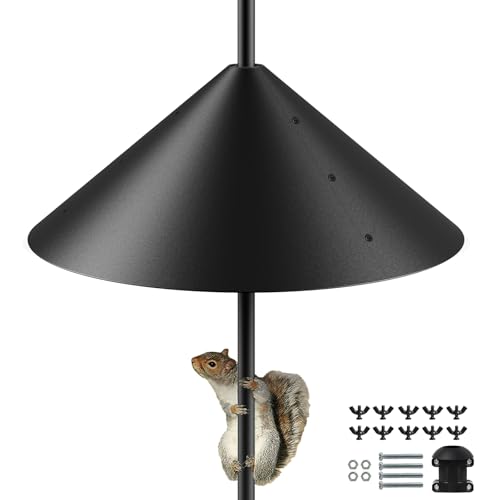
- Add a baffle to the pole, positioned with its bottom edge 4 to 5 feet up, such as the KITVONA 19 Inch Metal Squirrel Baffle.
- If the feeder still gets raided from the top, add a dome-style guard above a hanging feeder rather than only a pole baffle.
- Switch to a weight-activated or caged feeder body if the current one has no squirrel defense built in at all.
- Swap in seed squirrels are less interested in, like safflower, on the feeders they keep hitting hardest.
Work through these in order rather than jumping straight to hardware. A premium squirrel-proof feeder hung 4 feet from a deck rail still gets raided, while a basic hopper feeder placed correctly, 10 feet from anything a squirrel can jump from, already stops most attempts before a squirrel ever reaches it. For the full reasoning behind each distance, see the general bird feeder placement guide.
How far can squirrels jump?
A gray squirrel can cover roughly 8 to 10 feet horizontally from a running start and climb or leap about 4 to 5 feet straight up. That is why the standard advice for a squirrel-resistant pole feeder is 10 feet of clearance from any launch point in every direction, not just from the ground directly under the pole.
Squirrels are also strong climbers, not just jumpers, which is why a bare wooden post or a rough-barked tree defeats a baffle strategy entirely. A slick, smooth metal pole removes the climbing option, forcing a squirrel back to jumping, where the 10-foot distance rule and a correctly placed baffle can actually stop it.
Cage feeders vs weight-activated feeders: which works better?
Both mechanisms hold up well when placement is correct. A weight-activated feeder like the Squirrel Buster Plus tends to need less maintenance since it has fewer small gaps for seed to jam. A caged feeder is often cheaper and simpler mechanically, with nothing to spring back into place after use, but the cage has to be sized tightly enough that a determined squirrel cannot squeeze a paw through.
The Squirrel Buster Plus and the standard Squirrel Buster differ mainly in capacity, port count, and the addition of a cardinal ring that gives larger perching birds a stable landing spot around the ports. See the full Squirrel Buster Plus versus standard comparison for the capacity and price differences side by side before choosing between them.
| Mechanism | How it blocks squirrels | Maintenance |
|---|---|---|
| Weight-activated shroud | Closes ports under roughly 4+ oz of weight | Occasional spring or hinge check |
| Wire cage | Mesh too tight for a paw or head | Simple, few moving parts |
| Pole baffle | Blocks climbing up the pole itself | None once mounted |
Gear for this job
Prices move constantly; the button shows the current figure.

Do squirrel-proof bird feeder poles actually work?
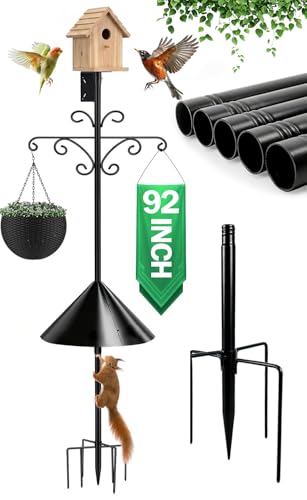
A dedicated pole like the 92 Inch Squirrel-Proof Bird Feeder Pole works when it is placed correctly, since the pole itself is only half the system. A slick metal pole is harder to climb than a wooden post or a tree trunk, but a squirrel that can jump onto the feeder from a nearby structure skips the pole entirely. Distance from launch points still matters more than the pole material.
Multi-arm feeding stations that hang several feeders from one pole need the same 10-foot clearance rule applied to the farthest-reaching arm, not just the pole's base. Measure from the tip of each hook outward when checking distance to a fence or roofline, since that is the point a squirrel actually has to reach, not the center of the pole itself. A baffle low on the pole cannot compensate for an arm that already extends within jumping range of a structure. For a side-by-side look at pole-mounted versus hanging setups, see pole versus hanging bird feeders.
Does seed choice matter for keeping squirrels off a feeder?
Safflower seed, such as Happy Wings Safflower Seed, is avoided by many squirrels along with grackles and starlings, while cardinals, chickadees, and other favorites still eat it readily. It is not a universal squirrel deterrent since some individual squirrels do learn to eat it, but pairing safflower with a weight-activated or caged feeder gives you two layers of defense instead of one. See safflower versus sunflower seed for how the two compare on cost per pound and which species prefer each one.
Black oil sunflower seed, by contrast, is one of the most squirrel-attractive seeds available precisely because of its high fat content, which is also why it draws the widest range of desirable songbirds. Feeders holding black oil sunflower benefit the most from strong mechanical squirrel-proofing, since seed choice alone will not discourage a squirrel from a feeder full of its favorite food.
Where exactly should a baffle sit on the pole?
Set the bottom edge of the baffle 4 to 5 feet above the ground. Any lower and a squirrel can jump over the top edge from a standing start beside the pole. Any higher and there is enough clear pole below the baffle for a squirrel to get a running start and boost off the pole itself before the baffle can stop it.
What you need
Prices move constantly; the button shows the current figure.

Get the printable checklist
One page with every item, the placement distances and the cleaning schedule. We send it once. No sales sequence.
Used only to send the checklist.Frequently asked questions
What makes a bird feeder squirrel proof?
A squirrel-proof feeder uses either a weight-activated shroud that seals its feeding ports under a squirrel weight of roughly 4 ounces or more, or a wire cage sized tightly enough that a squirrel cannot fit a paw through to the seed. Neither mechanism works on its own if the feeder still sits within jumping range of a deck rail, fence, or tree branch, so placement has to back up the hardware.
How can I make my bird feeder squirrel proof?
Move the feeder at least 10 feet from anything a squirrel could jump from, then add a pole baffle with its bottom edge 4 to 5 feet up. If the current feeder body has no built-in defense, replace it with a weight-activated or caged design. Safflower seed, avoided by many squirrels, adds a second layer without changing the hardware at all.
What is a squirrel-proof bird feeder pole made of?
Most squirrel-resistant poles use smooth powder-coated steel, since a slick metal surface is harder for a squirrel to grip than wood or a textured post. The pole material only matters once distance from jump points is already correct. A smooth pole 10 feet from a fence still gets raided if a squirrel can simply leap onto the feeder from the fence itself.
Do squirrel baffles really keep squirrels off feeders?
Yes, when mounted correctly at 4 to 5 feet up a pole that already sits 10 feet or more from any jump point. A baffle mounted too low lets a squirrel jump over its edge, and one on a pole within jumping range of a structure gets bypassed entirely. The baffle is one part of a system, not a standalone fix.
How far do squirrel-proof feeders need to be from trees?
Keep pole or hanging feeders at least 10 feet from any tree branch, since squirrels jump roughly 8 to 10 feet horizontally from a running start. A branch that looks too far to matter at 6 or 7 feet is still within range. Measure the actual gap rather than estimating by eye before mounting a permanent pole.