Pole vs Hanging Bird Feeder: Which Setup Should You Use?
For readers dealing with real squirrel pressure, a baffled pole feeding station is the setup that actually works: it lets you control the exact distance from trees, fences, and rooflines that squirrels launch from, something a feeder hanging from a tree branch or deck hook usually cannot do. Squirrels can jump roughly 8 to 10 feet horizontally and 4 to 5 feet straight up, so a pole needs to sit about 10 feet from any launch point with a baffle whose bottom edge sits 4 to 5 feet up the pole. A hanging feeder skips all of that math in exchange for faster, more flexible placement.
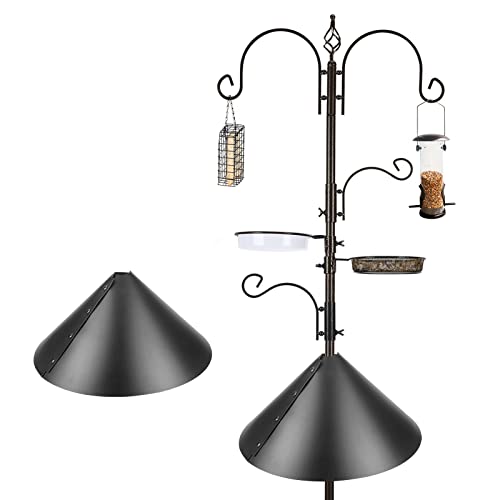
| Baffled pole system | Hanging from branch or hook | |
|---|---|---|
| Squirrel resistance | High, if distances are followed | Low, unless very carefully placed |
| Distance from launch points needed | 10 feet from trees, fences, rooflines | Often unavoidable near a branch |
| Baffle included | Yes, on most kits | Rarely practical to add |
| Wind sway | Minimal | Can swing in wind |
| Setup effort | Requires ground mounting | Quick, just a hook or branch |
| Flexibility of location | Fixed once installed | Easy to move or relocate |
| Best for | Serious squirrel problems | Light traffic, quick setup |
Both sides, current prices
Prices move constantly; the button shows the current figure.

Choose Baffled pole system if: Best for readers whose main priority is keeping squirrels off the feeder for good.
Choose Hanging from a branch or hook if: Best for readers with light squirrel pressure who want quick, flexible placement.
Why does a pole system beat hanging from a branch for squirrels?
Squirrels can jump roughly 8 to 10 feet horizontally and about 4 to 5 feet straight up, which means almost any feeder hanging directly from a tree branch (or a deck hook) sits well within reach of a squirrel already in that same tree. A pole system solves this by letting you place the feeder in open ground, at least 10 feet from the nearest tree, fence, or roofline a squirrel could launch from, with a baffle blocking the pole itself from being climbed.
What are the actual distances a baffle setup needs?
Position the pole at least 10 feet from any structure a squirrel could jump from, and mount the baffle so its bottom edge sits 4 to 5 feet up the pole, which is above a squirrel's vertical jump but low enough that nothing can climb underneath it. Skipping either measurement, too close to a launch point or a baffle mounted too high or too low, is the most common reason a "squirrel-proof" pole setup still gets raided.
| Measurement | Distance |
|---|---|
| Squirrel horizontal jump | 8 to 10 feet |
| Squirrel vertical jump | 4 to 5 feet |
| Pole distance from launch points | At least 10 feet |
| Baffle bottom edge height on pole | 4 to 5 feet up |
When is hanging from a branch or hook actually fine?
If your yard has genuinely light squirrel traffic, or you are feeding somewhere squirrels rarely visit at all, hanging a feeder from a sturdy deck hook or shepherd hook is a perfectly reasonable, much faster setup. It also suits renters or anyone who wants to reposition a feeder easily through the season, since a hanging feeder can move in minutes while a mounted pole system is effectively a fixed installation once it is in the ground.
Does wind affect a hanging feeder more than a pole feeder?
Yes, a feeder hanging freely from a branch or hook can swing noticeably in wind, which some birds tolerate fine and others avoid, and repeated swinging can also spill more seed than a stable mount. A pole-mounted feeder generally stays far more stationary, which both looks tidier under the feeder and keeps birds feeding more calmly, particularly for larger species that need a stable landing.
Can you combine both approaches in one yard?
Many yards run a baffled pole for the feeders that draw the most squirrel attention, like sunflower or peanut feeders, while keeping a lighter hanging setup elsewhere for something squirrels show less interest in, such as a nyjer feeder. See our feeder placement calculator and full bird feeder placement guide for laying out a yard with both.
Which setup should you choose?
Choose the baffled pole system if squirrels are already a problem or you want to prevent one before it starts. Choose hanging from a branch or a deck hook if your yard sees light squirrel pressure and you value quick, flexible placement over maximum squirrel resistance. Either way, review our feeder placement distances chart and best squirrel baffle roundup before you finalize a spot.
Get the printable checklist
One page with every item, the placement distances and the cleaning schedule. We send it once. No sales sequence.
Used only to send the checklist.Frequently asked questions
How far can squirrels actually jump to reach a bird feeder?
Squirrels can jump roughly 8 to 10 feet horizontally from a launch point like a tree, fence, or rooftop, and about 4 to 5 feet straight up from the ground or a nearby branch. These figures are why a feeder hanging directly from a tree branch is almost always within easy reach, while a pole placed at least 10 feet from any structure puts real distance between the squirrel and the feeder.
Where should a squirrel baffle be positioned on a pole?
Mount the baffle so its bottom edge sits 4 to 5 feet up the pole, above a squirrel's vertical jump range but low enough that nothing can climb the exposed pole beneath it. A baffle mounted too low leaves an unprotected gap a squirrel can leap into from the ground, while one mounted too high can still leave room for a squirrel to jump and grab the pole below it.
Can a hanging feeder ever be squirrel-resistant?
It can, but only if it hangs far enough from any tree, fence, rooftop, or other launch point to exceed a squirrel's 8 to 10 foot horizontal jump, which in practice usually means a freestanding pole or a long deck arm extended well away from structures rather than a branch directly overhead. Simply hanging a feeder from the nearest convenient branch rarely achieves this distance.
Does a pole system need to be set in concrete?
Not necessarily; many pole kits use a ground spike or auger-style base that holds firmly in typical soil without concrete, especially for lighter single-feeder setups. Heavier multi-arm feeding stations with several full feeders benefit from a sturdier base or deeper anchoring, since wind and the combined weight of filled feeders put more strain on the pole than a single lightweight feeder does.
Will switching from a hanging feeder to a pole system stop squirrels immediately?
Usually yes, if the distance and baffle height are both correct, since squirrels cannot exceed their physical jump limits regardless of how motivated they are. The most common reason a new pole setup still gets raided is a nearby structure, like an overhanging branch or a fence, that was not accounted for in the original 10 foot distance, so recheck all directions, not just the most obvious one.